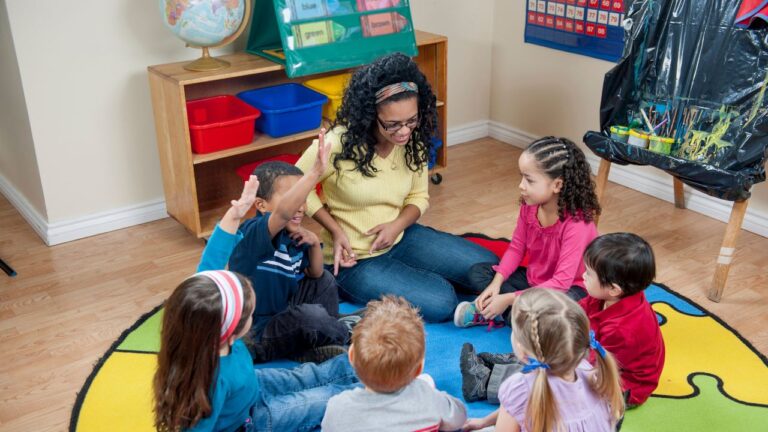
What If Participation Didn’t Mean “Jump In”?
(And Other Thoughts About Letting Kids Warm Up in Their Own Time)
So your preschooler is hanging back again.
They're at the edge of the group, watching quietly. Not exactly “joining in,” but definitely not zoning out either.
Here’s a little truth no one tells you loud enough:
Participation doesn’t start with jumping in. It starts with watching.
Yup. That subtle hover on the sidelines? That’s the beginning.
Before a child raises their hand...
Before they grab a block or say, “Can I play too?”...
They’re checking things out. Thinking about whether this is a space they’re allowed to be in. Whether it’s safe to try.
And as adults- parents, teachers, caregivers- how we respond to that moment can effect what happens next.
Let’s talk about how to make participation feel possible. Not pressured. Not performative. Just... inviting.
1. Treat Watching as Participation (Because It Is)
If you’ve ever had a kid sit near the action but not join in-
hovering like a tiny, socially-anxious satellite- you’ve probably wondered:
“Should I be encouraging them to do something?”
Here’s the thing: watching is doing something.
It’s observational learning. It’s risk-assessment.
And when adults accept watching as valid, kids can relax. That relaxation? It’s what opens the door to real participation- on their own terms.
(Fun fact: I was 100% that kid. Quiet, observant, and lowkey loving every second of being a background character.)
2. Swap Instructions for Invitations
We’ve all said it:
- “Come on, just try it.”
- “You need to join in.”
- “Go play with the others.”
Even when we mean well, those words can feel like pressure- especially for a cautious or slow-to-warm-up child.
Instead? Try:
- “I’m going to start- you can join me if you want.”
- “You can watch for a bit. I saved a spot if you feel like jumping in.”
Invitations = open doors.
Instructions = obligations.
And we all know which one we’d rather walk through.
3. Partial Participation Is Still Participation
Sometimes, a child joins for one minute.
Sometimes they tap a block and peace out.
Sometimes they hand you a crayon and then go back to observing.
That’s enough.
Tiny steps matter.
When adults celebrate the small joins instead of pushing for “more,” kids feel encouraged to come back the next time.
4. Lower the Risk, Not the Expectation
In school settings, participation often comes with expectations:
- Sit on the rug
- Answer the question
- Speak in front of the group
- Be “on” while someone checks a box
It can feel... big.
But participation blooms when the entry point is low.
Try offering ways to join in that:
- Don’t require speaking
- Let kids hold materials without using them
- Allow kids to sit nearby, without being in the spotlight
When it feels low-stakes, kids step forward more easily.
5. Skip the Spotlight (Even the Positive Kind)
We think calling attention to participation is encouraging:
- “Wow, look who’s joining us today!”
- “You did it! Everyone clap!”
But even positive callouts can feel like pressure- especially for quiet kids.
Kids participate more freely when they don’t feel watched.
Let the engagement unfold quietly. No mic drops or mini ovations needed.
6. Design the Environment for Participation (Not Just the Activity)
Sometimes, the barrier to participation isn’t the child.
It’s the environment.
Are we unintentionally creating high-stakes spaces with:
- Strict expectations?
- Timed activities?
- Pressure to “perform”?
Inside the Character Toolkit Hub, everything is built with multiple entry points.
That means children can:
- Watch first
- Engage partially
- Join in fully
...without any pressure. Participation is baked into the structure- so you don’t have to force it.
One More Thing: Participation Isn’t a Personality Trait
It’s not about whether a child is “shy” or “bold” or “a leader.”
It’s about whether the environment feels comfortable enough to step into.
When adults lower the pressure, authentic participation grows- quietly and gradually..
And when kids feel comfortable enough to engage, something magical happens:
They start to care about the space.
They notice how it runs.
They want to help- not because they’re told to, but because they feel connected.
Want ready-to-use activities designed with these principles in mind?
The Character Toolkit Hub has your back.